
When couples experience difficulty conceiving naturally, assisted reproductive treatments such as In Vitro Fertilisation (IVF) and Intracytoplasmic Sperm Injection (ICSI) can offer an opportunity to achieve pregnancy. Both treatments involve fertilising eggs outside the body in a laboratory, but they use different techniques to achieve fertilisation.
Understanding ICSI vs IVF is important when deciding which fertility treatment may be appropriate for your circumstances. While conventional IVF allows sperm to fertilise an egg naturally in a laboratory dish, ICSI involves injecting a single sperm directly into an egg using specialised equipment.
The choice between these treatments depends on several factors, including sperm quality, egg quality, previous fertility treatment outcomes, reproductive health and the underlying cause of infertility.
In this guide, we explain the differences between ICSI and IVF, how each procedure works, who may benefit from each treatment, their success rates, costs, potential risks and important considerations before starting treatment.
What Is the Difference Between ICSI and IVF?
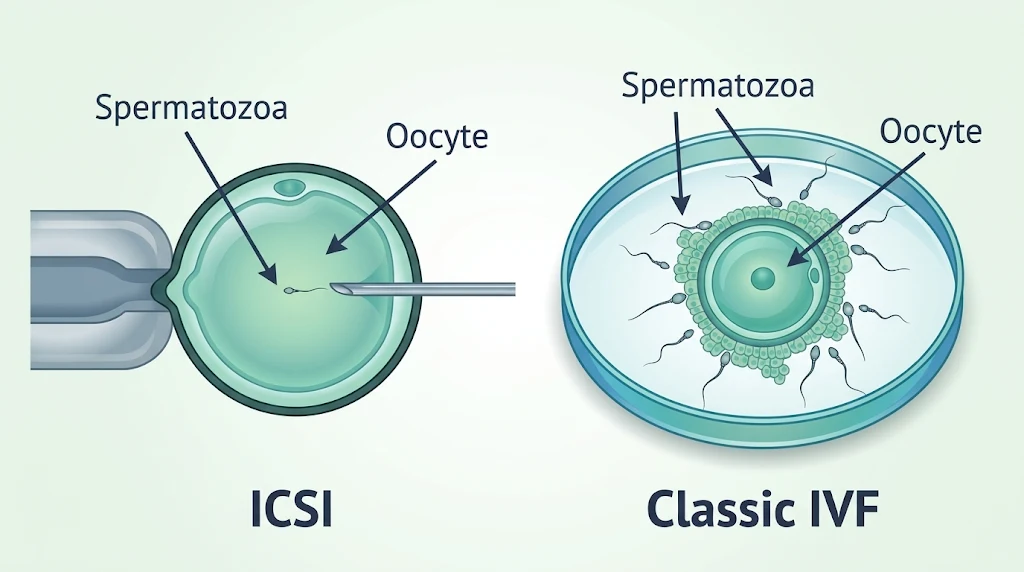
The main difference between ICSI and conventional IVF is how fertilisation takes place in the laboratory.
In conventional IVF, several sperm are placed around each mature egg in a laboratory dish. One sperm must naturally penetrate the egg to achieve fertilisation.
In ICSI, an embryologist selects a single sperm and injects it directly into the mature egg using a specialised microscopic needle.
Both procedures involve ovarian stimulation, egg retrieval, laboratory fertilisation, embryo development and embryo transfer. Therefore, ICSI is not a completely separate fertility treatment; it is a specialised fertilisation technique performed as part of an IVF cycle.
ICSI vs IVF: Quick Comparison
| Feature | Conventional IVF | ICSI |
|---|---|---|
| Full name | In Vitro Fertilisation | Intracytoplasmic Sperm Injection |
| Fertilisation method | Sperm and eggs are placed together | One sperm is injected directly into an egg |
| Sperm requirement | Sufficient number of functional sperm | A single suitable sperm per mature egg |
| Common indication | Various fertility problems, including tubal infertility | Primarily significant male-factor infertility |
| Laboratory technique | Conventional insemination | Micromanipulation |
| Egg retrieval | Required | Required |
| Embryo development | Takes place in the laboratory | Takes place in the laboratory |
| Embryo transfer | Required | Required |
| Success rates | Depend on individual circumstances | Depend on individual circumstances |
| Additional laboratory procedure | Conventional insemination | Specialised sperm injection |
Important: ICSI does not automatically produce a higher pregnancy or live birth rate than conventional IVF. Its main advantage is that it can overcome certain sperm-related fertilisation difficulties.
What Is IVF (In Vitro Fertilisation)?
In Vitro Fertilisation, commonly known as IVF, is an assisted reproductive technology in which eggs and sperm are brought together outside the body to achieve fertilisation.
The resulting embryos are cultured in a specialised laboratory before an appropriate embryo is transferred into the uterus.
IVF can help individuals and couples experiencing different fertility problems, particularly when natural conception is difficult because of blocked fallopian tubes, ovulation disorders, endometriosis, unexplained infertility or certain male reproductive problems.
How Does the IVF Procedure Work?
An IVF treatment cycle generally involves the following stages:
1. Fertility Assessment
Before beginning treatment, the fertility specialist evaluates both partners’ reproductive health. This may include medical history, ultrasound examinations, hormone testing and semen analysis.
2. Ovarian Stimulation
The woman receives prescribed fertility medications to stimulate the ovaries to develop multiple follicles containing eggs.
3. Monitoring Follicle Development
Ultrasound examinations and sometimes blood tests are performed to monitor follicle growth and determine when the eggs are ready for collection.
4. Egg Retrieval
Once the follicles are sufficiently developed, a trigger medication is administered. Egg retrieval is usually performed approximately 34–36 hours later using a specialised needle under ultrasound guidance, generally with sedation.
5. Sperm Collection and Preparation
A semen sample is collected and processed in the laboratory to identify sperm suitable for fertilisation.
6. Fertilisation
The collected eggs are placed in a laboratory dish with prepared sperm. The sperm must penetrate the eggs naturally to achieve fertilisation.
7. Embryo Development
Successfully fertilised eggs develop into embryos under carefully controlled laboratory conditions. Embryologists monitor their development over the following days.
8. Embryo Transfer
An appropriate embryo is transferred into the uterus using a thin catheter. Any suitable remaining embryos may be frozen for future use.
9. Pregnancy Testing
A pregnancy blood test is performed at the appropriate time following embryo transfer to determine whether implantation has resulted in pregnancy.
What Is ICSI (Intracytoplasmic Sperm Injection)?
Intracytoplasmic Sperm Injection, commonly called ICSI, is a specialised fertility procedure in which a single sperm is directly injected into the cytoplasm of a mature egg.
The procedure is performed by an experienced embryologist using a high-powered microscope and specialised micromanipulation equipment.
Unlike conventional IVF, ICSI does not require the sperm to swim towards, attach to and penetrate the egg independently. Instead, the embryologist selects a suitable sperm and introduces it directly into the egg.
The ICSI fertility procedure is particularly useful for couples experiencing significant male-factor infertility, including low sperm count, poor sperm movement or certain sperm abnormalities.
How Does the ICSI Procedure Work?
The ICSI process follows almost the same treatment stages as conventional IVF. The main difference occurs during laboratory fertilisation.
1. Initial Fertility Evaluation
Both partners undergo fertility investigations to identify possible causes of infertility. Semen analysis is particularly important when considering ICSI treatment.
2. Ovarian Stimulation
Fertility medications are prescribed to stimulate the ovaries to produce multiple follicles containing eggs.
3. Monitoring and Egg Retrieval
The fertility specialist monitors follicle development through ultrasound examinations. Once the follicles are ready, the eggs are collected using an ultrasound-guided procedure.
4. Sperm Collection and Preparation
A semen sample is collected and processed to identify suitable sperm. If sperm are absent from the ejaculate because of certain medical conditions, surgical sperm retrieval may be considered.
5. Selection of a Single Sperm
An embryologist examines the available sperm and selects an individual sperm for injection into each mature egg.
6. Direct Sperm Injection
Using specialised micromanipulation equipment, the embryologist holds the egg in position and injects the selected sperm directly into its cytoplasm using a very fine glass needle.
7. Fertilisation Assessment
The eggs are examined after injection to determine how many have successfully fertilised.
8. Embryo Development
Fertilised eggs are cultured in the laboratory and monitored as they develop into embryos.
9. Embryo Transfer
An appropriate embryo is transferred into the uterus. Additional suitable embryos may be cryopreserved for future treatment.
10. Pregnancy Testing
A blood pregnancy test is performed following the recommended waiting period to determine whether pregnancy has occurred.
ICSI vs IVF: Understanding the Major Differences
Although both procedures share several treatment stages, their differences are important when selecting an appropriate fertility approach.
1. Difference in Fertilisation Technique
This is the most significant difference between the two treatments.
In conventional IVF, sperm and eggs are placed together in a laboratory dish. Fertilisation depends on the sperm’s ability to reach and penetrate the egg.
In ICSI, the embryologist manually injects one selected sperm into the egg. This bypasses the natural process of sperm penetration.
2. Difference in Sperm Requirements
Conventional IVF generally requires an adequate number of functional sperm with sufficient movement and the ability to fertilise an egg.
ICSI can be particularly helpful when sperm count is extremely low, sperm movement is poor or sperm have difficulty fertilising eggs naturally.
It may also allow fertilisation using surgically retrieved sperm in selected cases.
3. Difference in Male Infertility Treatment
ICSI is commonly recommended for specific male-factor infertility conditions.
These may include:
- Severe oligospermia (very low sperm count).
- Asthenozoospermia (poor sperm motility).
- Teratozoospermia (abnormal sperm morphology).
- Obstructive azoospermia (absence of sperm in semen due to a blockage).
- Certain cases of non-obstructive azoospermia where sperm can be retrieved surgically.
- Previous failed or very low fertilisation with conventional IVF.
Conventional IVF may be suitable when sperm quality is adequate for natural fertilisation in the laboratory.
4. Difference in Laboratory Procedures
Conventional IVF requires the embryologist to prepare sperm and eggs and place them together under controlled laboratory conditions.
ICSI requires additional laboratory expertise and specialised equipment. The embryologist must examine individual sperm, select an appropriate one and inject it directly into each mature egg.
5. Difference in Treatment Cost
ICSI generally involves additional laboratory procedures, specialised equipment and embryologist expertise. Therefore, it may cost more than conventional IVF.
However, the total IVF or ICSI treatment cost depends on the fertility clinic, medications, laboratory services, additional procedures and individual treatment requirements.
6. Difference in Fertilisation Success
ICSI can improve the likelihood of fertilisation when sperm-related problems prevent natural fertilisation.
However, successful fertilisation does not guarantee successful embryo development, implantation or pregnancy.
Both treatments depend on several biological factors, including egg quality, sperm characteristics, embryo development and the woman’s reproductive health.
When Is ICSI Recommended Instead of IVF?
ICSI is generally considered when there is a specific medical reason to use direct sperm injection rather than conventional insemination.
A fertility specialist may recommend ICSI in the following situations:
1. Low Sperm Count
Oligospermia refers to a lower-than-normal sperm concentration in semen.
When sperm count is severely reduced, conventional IVF may have difficulty achieving fertilisation. ICSI allows an embryologist to select an individual sperm for injection into each mature egg.
2. Poor Sperm Motility
Sperm motility refers to the ability of sperm to move effectively.
When sperm have difficulty swimming towards an egg or penetrating its outer layer, ICSI may help overcome this particular fertilisation barrier.
3. Abnormal Sperm Morphology
Sperm morphology describes the size and shape of sperm.
Certain sperm abnormalities may affect fertilisation potential. When significant male-factor abnormalities are present, ICSI may be considered following a complete semen assessment.
However, abnormal morphology alone does not automatically mean ICSI is necessary.
4. Azoospermia and Surgically Retrieved Sperm
Azoospermia means that sperm are not present in the ejaculated semen.
In selected cases, sperm may be retrieved directly from the testicles or epididymis through procedures such as:
- Testicular sperm aspiration (TESA).
- Testicular sperm extraction (TESE).
- Microdissection testicular sperm extraction (Micro-TESE).
- Percutaneous epididymal sperm aspiration (PESA).
- Microsurgical epididymal sperm aspiration (MESA).
When suitable sperm are successfully retrieved, ICSI is commonly used to achieve fertilisation.
5. Previous Failed IVF Fertilisation
Some couples experience complete fertilisation failure or very low fertilisation during a previous conventional IVF cycle.
After reviewing the previous treatment results, a fertility specialist may recommend ICSI in a subsequent cycle to address the fertilisation problem.
6. Use of Frozen Eggs
ICSI is commonly used to fertilise previously frozen and thawed eggs because the freezing and thawing process can affect the egg’s outer structures.
The most appropriate fertilisation technique should be determined by the embryology team.
When Is Conventional IVF a Better Option?
Conventional IVF may be appropriate when the sperm sample has sufficient quality for fertilisation without direct injection.
It may be recommended in situations such as:
- Blocked or damaged fallopian tubes.
- Ovulation disorders that have not responded to other treatments.
- Endometriosis-related infertility.
- Unexplained infertility after appropriate assessment.
- Infertility involving female reproductive factors when sperm parameters are suitable.
- Certain cases where previous fertility treatments have been unsuccessful.
The decision should be based on a complete fertility assessment rather than choosing a procedure simply because it appears more advanced.
ICSI vs IVF Success Rate: Which Has a Higher Chance of Pregnancy?
One of the most common questions couples ask is whether ICSI has a higher success rate than IVF.
The answer depends on the underlying cause of infertility.
ICSI can improve fertilisation outcomes in couples with significant male-factor infertility because it bypasses certain sperm-related barriers. However, it does not necessarily improve pregnancy or live birth rates compared with conventional IVF.
For couples without significant male-factor infertility or previous fertilisation failure, current evidence does not establish that routinely using ICSI improves the chance of having a baby.
Factors That Affect IVF and ICSI Success Rates
Several factors influence the outcome of both treatments.
1. Female Age
Age is one of the most important factors affecting fertility treatment outcomes. Egg quantity and quality generally decline with increasing age, which can influence embryo development and pregnancy chances.
2. Egg Quality
The maturity and developmental potential of retrieved eggs affect fertilisation and embryo development.
3. Sperm Quality
Sperm count, motility, morphology and genetic factors can influence fertilisation and embryo development.
4. Embryo Quality
The ability of an embryo to develop normally and continue growing is an important factor in successful implantation and pregnancy.
5. Ovarian Reserve
Ovarian reserve indicates the remaining quantity of eggs in the ovaries. Tests such as Anti-Müllerian Hormone (AMH) and antral follicle count (AFC) can help assess ovarian reserve.
6. Uterine Health
The condition of the uterus and endometrium can influence embryo implantation. Certain uterine abnormalities may require evaluation or treatment before embryo transfer.
7. Underlying Medical Conditions
Conditions such as endometriosis, uterine abnormalities, hormonal disorders and certain systemic health problems may affect treatment outcomes.
8. Previous Fertility Treatment History
Previous IVF or ICSI cycles provide valuable information about ovarian response, fertilisation, embryo development and implantation.
Does ICSI Increase the Chance of Pregnancy?
ICSI can increase fertilisation chances in selected couples, particularly those with severe male-factor infertility or previous fertilisation failure.
However, fertilisation is only one stage of fertility treatment.
A successfully fertilised egg must develop into a suitable embryo, implant in the uterus and continue developing for pregnancy to result.
Therefore, ICSI should be selected when clinically indicated rather than assuming that direct sperm injection will always produce better pregnancy outcomes.
ICSI Procedure Cost vs IVF Treatment Cost
The cost of fertility treatment is an important consideration for couples planning IVF or ICSI.
Although both procedures share several treatment stages, ICSI may involve additional laboratory expenses because of the specialised sperm injection technique.
What Determines the ICSI Procedure Cost?
The total ICSI procedure cost can vary depending on:
- Fertility specialist consultation and assessment.
- Hormonal investigations and ultrasound examinations.
- Ovarian stimulation medications.
- Egg retrieval procedure.
- Sperm collection and preparation.
- Embryologist and laboratory charges.
- Specialised ICSI equipment and procedures.
- Embryo culture and monitoring.
- Embryo transfer.
- Embryo freezing and storage, if required.
- Additional procedures such as surgical sperm retrieval.
What Determines IVF Treatment Cost?
The overall IVF treatment cost depends on the treatment plan and services included in the package.
Common expenses include:
- Initial fertility consultation.
- Hormone tests and ultrasound scans.
- Fertility medications.
- Egg collection.
- Sperm preparation.
- Laboratory fertilisation.
- Embryo development and monitoring.
- Embryo transfer.
- Anaesthesia or sedation.
- Embryo freezing and storage, if applicable.
Is ICSI More Expensive Than IVF?
In many fertility clinics, ICSI costs more than conventional IVF because it requires an additional specialised laboratory procedure.
However, the difference varies between clinics and treatment packages.
Before starting treatment, couples should request a detailed cost breakdown and confirm whether medications, egg retrieval, embryo transfer, freezing and other necessary services are included.
The cheapest treatment is not necessarily the most suitable option. Choosing the correct procedure based on medical indications can help avoid unnecessary expenses and inappropriate treatment.
Risks and Possible Complications of ICSI and IVF
IVF and ICSI are established fertility treatments, but both involve medical procedures and certain potential risks.
Understanding these risks helps couples make informed decisions.
Risks Associated With IVF
Potential complications include:
Ovarian Hyperstimulation Syndrome (OHSS): An exaggerated response to fertility medications can cause enlarged ovaries, abdominal discomfort, nausea and, in severe cases, fluid accumulation and other complications.
Multiple Pregnancy: Transferring more than one embryo can increase the likelihood of twins or higher-order pregnancies, which carry additional maternal and pregnancy risks.
Ectopic Pregnancy: In some cases, an embryo implants outside the uterus, most commonly in a fallopian tube.
Egg Retrieval Complications: These may include bleeding, infection or injury to nearby structures, although serious complications are uncommon.
Emotional and Physical Stress: Fertility treatment can involve hormonal changes, frequent appointments, uncertainty and emotional pressure.
Additional Risks Associated With ICSI
ICSI involves directly injecting a sperm into an egg, which introduces some additional considerations.
Egg Damage: The injection procedure can occasionally damage an egg, making it unsuitable for further development.
Fertilisation Failure: Not every injected egg successfully fertilises. ICSI cannot guarantee fertilisation.
Genetic Considerations: Some forms of male infertility have an underlying genetic cause that may be passed on to children. Genetic counselling and testing may be appropriate in selected cases.
Research has also identified possible associations between ICSI and certain uncommon birth or developmental conditions. However, it can be difficult to separate risks related to the procedure from those associated with the underlying infertility.
A fertility specialist should explain the potential benefits and risks based on the couple’s individual medical circumstances.
Can ICSI Be Performed Without Male Infertility?
Yes, ICSI can technically be performed even when sperm parameters are normal.
However, this does not mean it is routinely necessary or provides better outcomes.
In couples without significant male-factor infertility or previous fertilisation failure, conventional IVF is often an appropriate approach.
Current reproductive medicine guidance does not recommend routine ICSI for every IVF cycle because it has not demonstrated a consistent improvement in live birth rates for patients without an appropriate indication.
The decision should consider previous fertilisation outcomes, egg characteristics, sperm quality and the specific clinical circumstances.
Can ICSI Fail Even If a Good Sperm Is Selected?
Yes. Selecting a suitable sperm improves the laboratory procedure but does not guarantee successful fertilisation or pregnancy.
ICSI can fail for several reasons:
- The injected egg may not survive the procedure.
- The egg may fail to activate after sperm injection.
- The sperm may have underlying functional or genetic problems.
- The egg may have poor developmental potential.
- Fertilisation may occur, but the embryo may stop developing.
- The embryo may fail to implant after transfer.
This is why successful ICSI treatment depends on more than simply selecting and injecting a sperm.
What Happens After Fertilisation in IVF and ICSI?
Once fertilisation has occurred, embryo development follows broadly similar stages in both treatments.
Day 1: Fertilisation Confirmation
The embryologist checks the eggs for evidence of normal fertilisation, commonly identified by the presence of two pronuclei.
Day 2: Early Embryo Development
The fertilised egg begins dividing into multiple cells.
Day 3: Cleavage-Stage Embryo
The embryo generally reaches approximately six to eight cells, although development varies.
Day 4: Morula Stage
The cells continue dividing and compacting into a developing embryo known as a morula.
Day 5 or 6: Blastocyst Development
Some embryos develop into blastocysts, which contain an inner cell mass and an outer cell layer. Blastocysts may be considered for transfer or freezing, depending on their development and clinical circumstances.
Embryo development is assessed by embryologists to help determine which embryos are suitable for transfer or cryopreservation.
IVF vs ICSI: Frequently Asked Questions
1. Is ICSI Better Than IVF?
Neither procedure is universally better. ICSI is particularly useful for significant male-factor infertility and certain cases of previous fertilisation failure. Conventional IVF is appropriate for many couples when sperm quality is adequate.
The best treatment depends on the underlying fertility problem and individual medical assessment.
2. Is ICSI More Successful Than IVF?
ICSI may improve fertilisation rates when sperm-related problems interfere with natural fertilisation. However, it does not consistently improve pregnancy or live birth rates compared with conventional IVF in couples without significant male-factor infertility.
3. Is ICSI a Type of IVF?
Yes. ICSI is a specialised fertilisation technique performed within an IVF treatment cycle. Both treatments involve egg retrieval, laboratory embryo development and embryo transfer.
4. Does ICSI Guarantee Fertilisation?
No. Although ICSI bypasses the need for sperm to penetrate the egg independently, some injected eggs may not fertilise. Fertilisation and subsequent embryo development cannot be guaranteed.
5. Can ICSI Be Used for Severe Male Infertility?
Yes. ICSI is commonly recommended for severe male-factor infertility, including very low sperm count, poor sperm motility and certain cases involving surgically retrieved sperm.
6. Is ICSI More Expensive Than IVF?
ICSI is often more expensive because it requires specialised laboratory equipment and additional embryologist expertise. However, actual treatment costs vary depending on the clinic and services included.
7. How Long Does the ICSI Process Take?
An ICSI cycle generally takes several weeks, similar to conventional IVF. The timeline depends on ovarian stimulation, egg retrieval, embryo development and the timing of embryo transfer.
8. Can ICSI Be Used After Failed IVF?
Yes. If conventional IVF results in complete or unexpectedly low fertilisation, a fertility specialist may recommend ICSI in a subsequent treatment cycle after reviewing the previous results.
9. Does ICSI Improve Embryo Quality?
ICSI helps sperm enter the egg but does not directly improve the genetic quality or developmental potential of an embryo. Embryo quality depends on several biological factors, including egg and sperm characteristics.
10. Can ICSI Be Used With Frozen Sperm?
Yes. ICSI can be used with frozen and thawed sperm, including sperm obtained through certain surgical retrieval procedures. Suitability depends on the available sperm and individual circumstances.
11. Which Is Better for Low Sperm Count: IVF or ICSI?
ICSI is generally preferred when sperm count is severely reduced because it requires only one suitable sperm for each mature egg being injected. The final decision depends on semen analysis and the overall fertility assessment.
12. Can IVF or ICSI Be Repeated?
Yes. Both treatments can be repeated when medically appropriate. The decision depends on previous treatment outcomes, age, ovarian reserve, embryo availability and the couple’s overall health.
How to Choose Between ICSI and IVF?
Choosing between conventional IVF and ICSI requires an individualised fertility assessment.
Before recommending treatment, a fertility specialist generally considers:
- The woman’s age and reproductive history.
- Ovarian reserve and hormone levels.
- Egg quantity and expected maturity.
- Semen analysis results.
- Previous fertilisation or IVF outcomes.
- Underlying fertility conditions.
- Uterine health.
- Any relevant genetic factors.
For couples with normal sperm parameters and no history of fertilisation failure, conventional IVF may be sufficient.
For couples with significant male-factor infertility, ICSI may offer a more appropriate fertilisation approach.
A detailed consultation with an experienced fertility specialist and embryology team can help determine which treatment offers the most appropriate approach for the individual circumstances.
Conclusion: ICSI vs IVF – Making an Informed Fertility Treatment Decision
Both IVF and ICSI are valuable assisted reproductive technologies that help individuals and couples overcome different fertility challenges.
The primary difference is the fertilisation technique. Conventional IVF allows sperm to fertilise an egg naturally in a laboratory dish, whereas ICSI involves injecting a single sperm directly into a mature egg.
ICSI is particularly beneficial in selected cases of male-factor infertility, previous fertilisation failure and certain situations involving surgically retrieved or frozen sperm. Conventional IVF remains an effective option for many couples when sperm quality is suitable for natural fertilisation.
Ultimately, the right treatment is not necessarily the more advanced or expensive procedure. It is the one that addresses the underlying fertility problem and is supported by an appropriate medical assessment.
If you are considering fertility treatment, consult a qualified fertility specialist to understand your diagnosis, available treatment options, expected outcomes and the most suitable approach for your reproductive health.
