
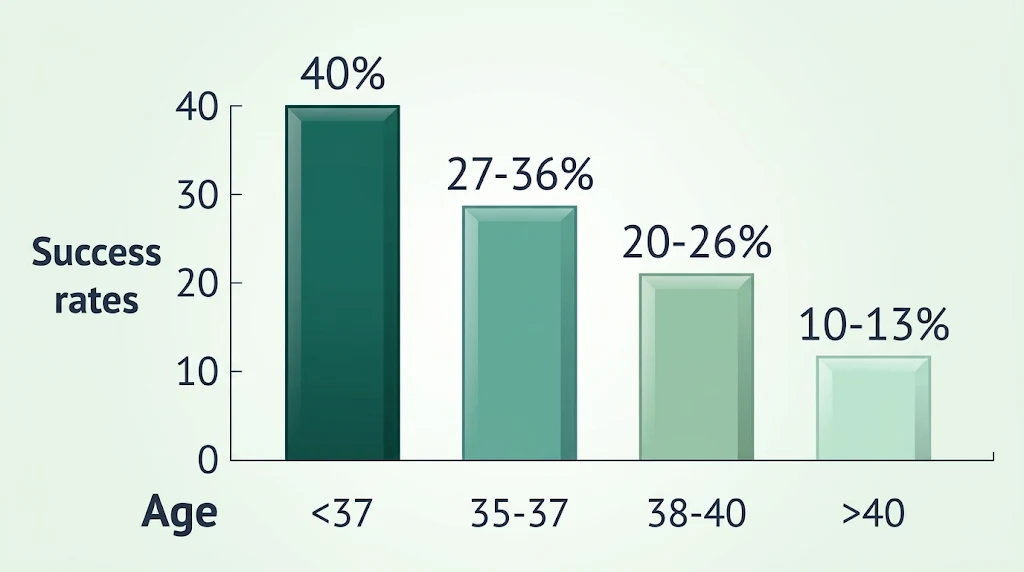
Age is one of the most important factors influencing the success of In Vitro Fertilisation (IVF). Although fertility treatment can help individuals and couples overcome different reproductive challenges, the chances of achieving pregnancy generally change as a woman gets older.
This is primarily because the number and quality of eggs naturally decline with age. As a result, older women may produce fewer eggs during ovarian stimulation, have fewer chromosomally normal embryos and experience a higher risk of miscarriage.
Understanding the IVF success rate by age can help couples develop realistic expectations, explore appropriate treatment options and make informed decisions about their fertility journey.
Whether you are considering IVF in your 20s, 30s or 40s, this guide explains how age affects fertility treatment outcomes, the chances of pregnancy at different ages, factors that influence success and what you can do to prepare for treatment.
What Is the Average IVF Success Rate by Age?
The IVF success rate varies significantly depending on the woman’s age, particularly when using her own eggs.
Women generally have higher IVF success rates in their younger reproductive years. Success rates gradually decline during the 30s, with a more noticeable decrease after age 35. The decline becomes more pronounced after 40.
According to the UK Human Fertilisation and Embryology Authority (HFEA), preliminary national data for 2022 reported the following live birth rates per embryo transferred during fresh IVF treatment:
| Woman’s age | Live birth rate per embryo transferred |
|---|---|
| 18–34 years | 35% |
| 40–42 years | 10% |
| 43–44 years | 5% |
These are population-level UK figures, not guaranteed outcomes or individual predictions. They relate to fresh embryo transfers and should not be interpreted as success rates per complete IVF cycle or cumulative success after multiple transfers.
IVF Success Rate in Your 20s (Age 20–29)
Women in their 20s generally have the highest reproductive potential because egg quality and ovarian reserve are usually better during this period.
For women experiencing infertility, IVF can offer favourable outcomes when the underlying reproductive problem can be addressed through assisted reproductive technology.
Why Are IVF Success Rates Higher in Your 20s?
Several biological factors contribute to better fertility treatment outcomes at younger ages:
- Better egg quality: A higher proportion of eggs are likely to have the correct number of chromosomes.
- Good ovarian reserve: Women generally have a larger remaining pool of eggs.
- Higher embryo development potential: A greater proportion of fertilised eggs may develop into suitable embryos.
- Lower miscarriage risk: The risk of pregnancy loss related to age-associated chromosomal abnormalities is generally lower.
- Better reproductive health: Certain age-related reproductive conditions are less common.
Can Women in Their 20s Still Need IVF?
Yes. Younger women can experience infertility due to different medical conditions, including:
- Blocked or damaged fallopian tubes.
- Severe endometriosis.
- Polycystic ovary syndrome (PCOS) with additional fertility challenges.
- Severe male-factor infertility.
- Premature ovarian insufficiency.
- Certain genetic or reproductive conditions.
- Unexplained infertility.
A younger age does not guarantee natural conception or IVF success. The underlying cause of infertility and the health of both partners remain important.
IVF Success Rate at Age 30–34
Women between 30 and 34 generally continue to have favourable IVF outcomes, although fertility gradually changes during this period.
Egg quantity and quality may begin to decline, but many women in this age group still have a good chance of achieving pregnancy through IVF.
What Influences IVF Success Between 30 and 34?
The following factors can affect treatment outcomes:
- Ovarian reserve and the number of eggs retrieved.
- Egg maturity and fertilisation rates.
- Sperm quality and reproductive health.
- Embryo development and chromosomal status.
- Uterine health and endometrial thickness.
- Previous pregnancy and fertility treatment history.
For women in this age group, fertility specialists may recommend IVF based on the cause and duration of infertility rather than age alone.
IVF Success Rate at Age 35–37
Age 35 is an important milestone in reproductive health because female fertility generally begins declining more noticeably during the mid-to-late 30s.
However, many women between 35 and 37 continue to achieve successful pregnancies through IVF.
The main difference is that egg quality may become less predictable, and the proportion of eggs with chromosomal abnormalities gradually increases.
Why Does IVF Success Begin to Decline After 35?
As women age, several biological changes can affect reproductive outcomes:
1. Declining Egg Quality
Egg quality refers to the developmental potential of an egg. With increasing age, a higher proportion of eggs may contain chromosomal abnormalities.
2. Reduced Ovarian Reserve
The number of eggs remaining in the ovaries gradually decreases, which may affect the number of eggs retrieved during an IVF cycle.
3. Increased Risk of Embryo Chromosomal Abnormalities
Some embryos may have an abnormal number of chromosomes, which can affect implantation, pregnancy development and miscarriage risk.
4. Increased Miscarriage Risk
Age-related changes in egg quality can increase the likelihood of pregnancy loss.
Is IVF Successful After 35?
Yes. Many women achieve pregnancy after 35 through IVF.
However, the expected number of eggs, embryos and treatment cycles may differ from those of younger women.
A fertility specialist may recommend ovarian reserve testing and a detailed assessment to develop an appropriate treatment plan.
IVF Success Rate at Age 38–40
Between 38 and 40, the decline in female fertility becomes more significant.
Although IVF remains a treatment option, women in this age group may experience lower ovarian response, reduced egg quality and fewer chromosomally normal embryos.
The number of eggs retrieved during an IVF cycle can also vary considerably between individuals.
What Challenges Affect IVF Success at 38–40?
Common considerations include:
- Reduced ovarian reserve.
- Lower proportion of chromosomally normal eggs.
- Increased risk of embryo developmental abnormalities.
- Higher miscarriage risk.
- Fewer suitable embryos available for transfer.
- Greater likelihood of requiring additional treatment cycles.
Can IVF Work at Age 40?
Yes. Pregnancy through IVF is possible at age 40, particularly when a woman has an adequate ovarian response and suitable embryos.
However, success rates are generally lower than those for younger women using their own eggs.
An early fertility evaluation can help determine the most appropriate treatment approach and avoid unnecessary delays.
IVF Success Rate at Age 41–42
Women aged 41–42 may experience a further reduction in IVF success rates when using their own eggs.
At this stage, age-related changes in egg quality become increasingly important.
Even when the ovaries produce eggs during stimulation, not every egg will fertilise or develop into a suitable embryo.
What Affects IVF Outcomes at 41–42?
Several factors may influence the likelihood of pregnancy:
- Number of eggs retrieved.
- Percentage of mature eggs.
- Fertilisation rate.
- Embryo development.
- Chromosomal normality of embryos.
- Uterine and endometrial health.
- Previous IVF outcomes.
According to HFEA’s 2022 national data, the preliminary live birth rate for women aged 40–42 was approximately 10% per fresh embryo transferred.
Individual outcomes can be higher or lower depending on the clinical circumstances.
Is IVF Worth Considering at 42?
IVF may still be an option at 42, but couples should understand the potential limitations and realistic chances of success.
A fertility specialist can assess ovarian reserve, previous treatment history and other medical factors before recommending further treatment.
IVF Success Rate at Age 43–44
IVF success rates using a woman’s own eggs generally become considerably lower between ages 43 and 44.
The main reason is the increased proportion of eggs with chromosomal abnormalities, which can affect fertilisation, embryo development and the likelihood of a successful pregnancy.
Some women may still produce eggs and develop embryos suitable for transfer, but the chances of achieving a live birth are significantly reduced compared with younger age groups.
HFEA reported a preliminary live birth rate of approximately 5% per embryo transferred for women aged 43–44 using their own eggs in 2022.
Can Women at 43–44 Still Get Pregnant Through IVF?
Yes, pregnancy is possible, but the chances using one’s own eggs are relatively low.
Depending on individual circumstances, a fertility specialist may discuss:
- IVF using the woman’s own eggs.
- Embryo donation, where available.
- Further assessment of ovarian reserve and reproductive health.
The decision should consider medical suitability, personal preferences, ethical considerations and applicable regulations.
IVF Success Rate After Age 45
After age 45, achieving a successful pregnancy using one’s own eggs through IVF becomes increasingly difficult.
This is mainly due to the significant decline in egg quality and the higher proportion of chromosomally abnormal eggs.
Even if ovarian stimulation produces eggs, fewer may develop into embryos with the potential for a healthy ongoing pregnancy.
Is IVF Possible After 45?
IVF may be medically possible in selected women, depending on ovarian function, overall health and individual circumstances.
However, the likelihood of live birth using one’s own eggs is very low.
A specialist assessment is essential to understand the available options and pregnancy-related health risks.
Why Does IVF Success Rate Decrease With Age?
The relationship between age and IVF success is primarily associated with changes in ovarian reserve and egg quality.
Women are born with a finite number of eggs. This number gradually decreases throughout life, and the remaining eggs also undergo age-related changes.
1. Declining Ovarian Reserve
Ovarian reserve refers to the remaining quantity of eggs in the ovaries.
As a woman gets older, the number of available eggs decreases. This can result in fewer eggs being collected during an IVF cycle.
2. Declining Egg Quality
Egg quality is one of the most important factors affecting IVF outcomes.
Older eggs are more likely to contain chromosomal abnormalities, which can affect fertilisation, embryo development and implantation.
3. Increased Embryo Chromosomal Abnormalities
An embryo needs an appropriate number of chromosomes to develop normally.
As maternal age increases, the proportion of embryos with chromosomal abnormalities generally rises.
These abnormalities can reduce implantation chances and increase the likelihood of miscarriage.
4. Increased Miscarriage Risk
Pregnancy loss becomes more common with increasing maternal age.
One major reason is the higher likelihood of chromosomal abnormalities in the developing embryo.
5. Changes in Ovarian Response
Older women may respond differently to ovarian stimulation medications.
Some may produce fewer follicles and eggs, potentially reducing the number of embryos available for transfer.
6. Age-Related Reproductive Conditions
Certain conditions, including fibroids, endometriosis and tubal disease, become more common with age and may influence fertility or pregnancy outcomes.
These factors do not affect every woman equally, which is why individual assessment remains important.
Does IVF Success Depend on Age or Egg Quality?
Both factors are closely related.
Age is one of the strongest predictors of reproductive success because egg quality generally declines as women get older.
However, two women of the same age can have different ovarian reserves, egg quality and treatment outcomes.
For example, a woman aged 38 may produce several mature eggs during an IVF cycle, while another woman of the same age may have a reduced ovarian response.
Similarly, a younger woman may experience poor ovarian reserve due to premature ovarian insufficiency, previous ovarian surgery or other medical conditions.
Therefore, age should always be considered alongside other fertility indicators.
How Is IVF Success Rate Calculated?
IVF success rates can be reported in different ways. Understanding these measurements is important when comparing fertility clinics or evaluating treatment expectations.
1. Pregnancy Rate Per Embryo Transfer
This measures the percentage of embryo transfers that result in pregnancy.
However, not every pregnancy progresses to a live birth.
2. Live Birth Rate Per Embryo Transfer
This measures the percentage of embryo transfer procedures that result in a live birth.
It is generally a more meaningful outcome for couples evaluating their chances of having a baby.
3. Success Rate Per Egg Retrieval
This measures the likelihood of achieving pregnancy or live birth following an egg retrieval procedure.
It can provide a broader understanding of treatment outcomes because some patients may not have an embryo available for transfer.
4. Cumulative IVF Success Rate
Cumulative success rate considers the outcomes of multiple embryo transfers originating from one egg retrieval.
For example, if an egg retrieval produces several suitable embryos, the patient may undergo one fresh transfer and additional frozen embryo transfers.
Looking at the combined outcomes of these transfers provides a more complete picture than considering only the first transfer.
Important: Always ask whether a clinic is reporting pregnancy or live birth, and whether the figure is calculated per cycle started, egg retrieval or embryo transfer.
What Factors Affect IVF Success Besides Age?
Although age is a major factor, it is not the only consideration when estimating IVF success.
1. Ovarian Reserve
Ovarian reserve provides information about the remaining egg supply and expected response to fertility medications.
Common assessment methods include:
- Anti-Müllerian Hormone (AMH) blood test.
- Antral Follicle Count (AFC) through ultrasound.
- Follicle-Stimulating Hormone (FSH) testing.
These tests help predict ovarian response but cannot directly measure egg quality or guarantee pregnancy.
2. Sperm Quality
Male reproductive health also contributes to IVF outcomes.
Semen analysis evaluates:
- Sperm concentration.
- Sperm motility.
- Sperm morphology.
- Other relevant semen characteristics.
In selected cases, ICSI may be recommended to address significant sperm-related fertilisation problems.
3. Embryo Quality
Embryo quality is assessed through its development, appearance and other available investigations.
The ability of an embryo to develop normally is important for successful implantation and pregnancy.
4. Uterine Health
The uterus provides the environment in which an embryo implants and develops.
Conditions such as uterine fibroids, polyps, adhesions and certain congenital abnormalities may affect implantation or pregnancy.
A fertility specialist may recommend ultrasound or additional investigations when clinically indicated.
5. Underlying Infertility Diagnosis
The cause of infertility can influence treatment outcomes.
Examples include:
- Endometriosis.
- PCOS.
- Tubal factor infertility.
- Male-factor infertility.
- Unexplained infertility.
- Premature ovarian insufficiency.
6. Previous IVF Treatment History
Previous IVF cycles provide useful information about ovarian response, fertilisation, embryo development and implantation.
A specialist can use these findings to adjust the treatment plan where appropriate.
7. Lifestyle and General Health
Certain lifestyle and health factors may influence reproductive health, including:
- Smoking.
- Excessive alcohol consumption.
- Significant weight abnormalities.
- Poorly controlled medical conditions.
- Nutritional deficiencies.
- Certain medication exposures.
Maintaining a healthy lifestyle can support general reproductive health, although it cannot reverse age-related egg deterioration.
Can IVF Success Rates Be Improved?
There is no guaranteed method of increasing IVF success rates. However, appropriate medical assessment and individualised treatment planning can help optimise the chances of a favourable outcome.
1. Seek Fertility Advice Early
Women over 35 should generally seek a fertility evaluation after six months of unsuccessful attempts at conception. Women over 40 may benefit from an immediate evaluation rather than waiting.
Early assessment can help identify potential fertility problems and available treatment options.
2. Assess Ovarian Reserve
AMH testing and antral follicle count can help the fertility specialist understand ovarian reserve and plan ovarian stimulation.
3. Manage Existing Medical Conditions
Conditions such as thyroid disorders, diabetes, PCOS and endometriosis may require appropriate assessment and management before or during fertility treatment.
4. Maintain a Healthy Weight
Being significantly underweight or overweight may affect reproductive health and treatment planning.
A healthcare professional can recommend appropriate weight-management strategies when necessary.
5. Avoid Smoking
Smoking is associated with reduced female fertility and may negatively affect egg quality and reproductive outcomes.
Avoiding tobacco exposure is an important part of preconception health.
6. Follow an Individualised IVF Protocol
The fertility specialist may adjust medication types, doses and monitoring according to the patient’s age, ovarian reserve and previous treatment response.
7. Consider Embryo Testing When Appropriate
Preimplantation genetic testing for aneuploidy (PGT-A) examines embryos for chromosome-number abnormalities.
It may help identify embryos with a normal chromosome number for transfer in selected circumstances.
However, PGT-A does not create healthier embryos, guarantee implantation or increase cumulative live birth rates for every patient. Its benefits and limitations should be discussed with a fertility specialist.
Does Frozen Embryo Transfer Affect IVF Success by Age?
Frozen Embryo Transfer (FET) involves transferring a previously frozen embryo into the uterus during a later treatment cycle.
The age at which the eggs were collected is an important consideration when evaluating frozen embryo success.
For example, if a woman freezes embryos at age 32 and undergoes embryo transfer at age 38, the embryos retain the biological age associated with the eggs when they were collected.
This means that the age at egg retrieval is generally more relevant to embryo chromosomal potential than the woman’s age at the time of frozen embryo transfer.
However, the woman’s age and medical health at the time of pregnancy still matter because maternal age can influence pregnancy-related risks.
When Should You Consider IVF Based on Age?
The appropriate time to consider IVF depends on age, fertility history and the underlying reproductive condition.
The following general guidance can help couples understand when to seek professional advice.
| Age group | General fertility guidance |
|---|---|
| Under 35 | Seek evaluation after 12 months of unsuccessful attempts, unless a known fertility problem requires earlier assessment |
| 35–39 | Seek evaluation after 6 months of unsuccessful attempts |
| 40 and above | Consider immediate fertility evaluation |
| Any age with known infertility | Seek specialist advice without unnecessary delay |
These are general recommendations, not automatic indications for IVF.
A fertility specialist may recommend other treatments depending on the diagnosis, including ovulation induction, intrauterine insemination (IUI), surgery or IVF.
Frequently Asked Questions About IVF Success Rate by Age
1. What Is the Best Age for IVF?
IVF outcomes using a woman’s own eggs are generally more favourable during her 20s and early 30s. However, the best time for treatment depends on individual fertility health, reproductive history and medical circumstances.
2. Does IVF Work Better Before 35?
Generally, yes. Women under 35 tend to have better egg quality and a higher proportion of chromosomally normal embryos, which contributes to more favourable IVF outcomes.
3. What Is the IVF Success Rate at Age 30?
Women aged 30 generally have favourable IVF prospects when using their own eggs. However, the exact success rate depends on ovarian reserve, sperm quality, embryo development, infertility diagnosis and the outcome being measured.
4. What Is the IVF Success Rate at Age 35?
Many women achieve pregnancy through IVF at age 35. Although fertility begins declining during the mid-30s, successful treatment remains possible and outcomes vary between individuals.
5. What Is the IVF Success Rate at Age 38?
IVF can be successful at age 38, but outcomes are generally lower than in younger women. Egg quality, ovarian reserve and embryo development are important factors when estimating individual chances.
6. What Is the IVF Success Rate at Age 40?
The HFEA reported a live birth rate of approximately 10% per fresh embryo transferred for women aged 40–42 in its 2022 preliminary data. Individual outcomes may vary depending on the woman’s fertility health and treatment characteristics.
7. Can a 42-Year-Old Woman Get Pregnant Through IVF?
Yes. Pregnancy through IVF is possible at age 42, particularly when suitable embryos are available. However, success using one’s own eggs is generally lower than at younger ages.
9. Does AMH Predict IVF Success?
AMH helps estimate ovarian reserve and predict how the ovaries may respond to stimulation medication. However, it does not directly measure egg quality or accurately predict whether a particular patient will achieve pregnancy.
10. Does a Low AMH Level Mean IVF Will Fail?
No. A low AMH level does not automatically mean IVF will fail. It may indicate that fewer eggs could be retrieved during stimulation, but pregnancy can still occur depending on egg quality, embryo development and other individual factors.
11. Does ICSI Improve IVF Success in Older Women?
ICSI may help overcome certain sperm-related fertilisation problems, but it does not reverse age-related egg deterioration or guarantee better pregnancy outcomes. It should be recommended based on appropriate medical indications.
12. Does Embryo Quality Matter More Than Age?
Both are important. Age influences egg quality and the likelihood of obtaining chromosomally normal embryos. Embryo development and genetic characteristics also contribute to implantation and live birth outcomes.
14. How Many IVF Cycles Are Needed to Get Pregnant?
There is no fixed number of IVF cycles required to achieve pregnancy. Some women conceive after their first embryo transfer, while others may require multiple transfers or egg retrieval cycles. The number depends on age, ovarian response, embryo availability and individual fertility factors.
Conclusion: Understanding IVF Success Rates at Every Age
Age plays a significant role in determining the likelihood of success with IVF, particularly when using a woman’s own eggs.
Women in their 20s and early 30s generally have more favourable outcomes, while success rates gradually decline after 35 and become considerably lower after 40.
However, age alone does not determine whether IVF will work. Ovarian reserve, egg quality, sperm health, embryo development, uterine conditions and previous treatment outcomes all contribute to the overall chances of pregnancy.
Understanding these factors can help couples make informed decisions about fertility treatment and avoid unrealistic expectations.
If you are considering IVF, consult an experienced fertility specialist for an individual assessment. The right treatment plan should be based on your reproductive health, age, medical history and personal fertility goals rather than general success-rate statistics.
